Ordering pharmaceutical products is an important part of daily business operations for distributors, wholesalers and retailers. An efficient ordering process helps businesses manage purchases, track orders and maintain product availability for their customers.
Traditionally, many pharmaceutical businesses have placed orders through phone calls, paper records, messages or spreadsheets. Today, digital ordering systems and online B2B platforms offer another way to manage product selection and purchasing.
But which method works better for pharmaceutical businesses?
The answer depends on the size of the business, order frequency, product range and the tools available. In this blog, we compare manual and digital pharmaceutical ordering, explain their benefits and challenges, and explore how businesses can make their ordering process more efficient.
What Is Manual Pharmaceutical Ordering?
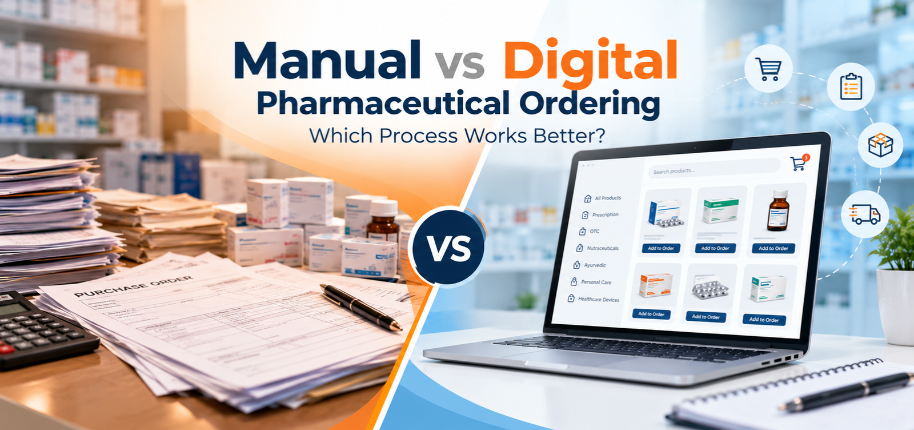
Manual pharmaceutical ordering refers to placing and managing orders through methods such as phone calls, paper-based purchase orders, emails, messaging applications or spreadsheets.
In this process, buyers typically contact suppliers, confirm product requirements, discuss quantities and prices, and record order details manually.
For example, a pharmacy retailer may call a distributor to ask about product availability and then send an order list through a messaging application.
Advantages of manual ordering
Personal communication: Buyers can speak directly with suppliers to discuss specific requirements.
Familiar process: Businesses that already use phone calls and written records may find manual ordering easy to follow.
Flexibility: Buyers can discuss changes or special requirements directly with their suppliers.
Challenges of manual ordering
Manual ordering can become difficult when businesses handle many products or place orders frequently.
Common challenges include:
Repeated phone calls to confirm availability.
Errors when recording product names, quantities or prices.
Difficulty tracking pending orders.
Time spent searching through old messages and purchase records.
Delays when order information must pass between multiple people.
These challenges may increase as the business grows and order volumes become more complex.
What Is Digital Pharmaceutical Ordering?
Digital pharmaceutical ordering uses online platforms, websites or software to help businesses explore products and manage purchasing activities.
Depending on the system, buyers may be able to view product information, select quantities, submit orders and review order details through a digital interface.
A B2B ordering website can bring product discovery and order placement into one online process, reducing the need for repeated manual communication for routine purchases.
Advantages of digital ordering
1. Convenient product discovery
Buyers can explore available product information online instead of contacting suppliers individually for every enquiry.
2. Organised order details
Digital systems can help maintain product selections, quantities and order records in a more structured format.
3. Easier order tracking
Where tracking features are available, businesses can review order progress without searching through multiple messages or documents.
4. Better record management
Digital records can make it easier to review previous purchases and prepare future orders, depending on the platform's features.
5. Support for business growth
Digital workflows may help businesses manage frequent orders and larger product ranges more efficiently.
Challenges of digital ordering
Digital ordering also has limitations that businesses should consider.
Employees may need training to use a new system.
Internet access and technical support may be necessary.
Product information and stock availability must be kept accurate.
Not every platform provides the same ordering, payment or tracking features.
Businesses must protect account access and handle commercial information appropriately.
Digital ordering works best when the platform is reliable, easy to use and supported by accurate product information.
Manual vs Digital Pharmaceutical Ordering: Key Differences
| Feature | Manual Ordering | Digital Ordering |
|---|---|---|
| Order placement | Calls, messages or written orders | Website, app or ordering software |
| Product discovery | Often requires direct enquiries | Product information may be available online |
| Order records | Paper, messages or spreadsheets | Digital records, depending on the system |
| Order tracking | May require manual follow-ups | Tracking tools may be available |
| Communication | Direct and personal | Digital communication, with human support where available |
| Scalability | Can become time-consuming as orders increase | Can support larger workflows when properly implemented |
| Best suited for | Simple or occasional orders | Frequent orders and structured purchasing workflows |
Neither method is automatically right for every business. The best choice depends on the ordering process, the supplier's capabilities and the needs of the buyer.
Which Ordering Method Works Better for Pharma Distributors?
For businesses handling frequent orders or a wide range of products, digital ordering can offer greater convenience and more organised records.
For example, a distributor who regularly purchases multiple product categories may benefit from being able to explore products online and maintain structured order information.
Manual ordering may still be useful when a purchase involves unusual requirements, product clarification or direct discussion with a supplier.
Many businesses can benefit from a combination of both methods: digital tools for routine ordering and direct communication for questions, special requirements or order-related issues.
The objective is not simply to replace every manual activity. It is to reduce unnecessary work while maintaining accuracy, reliable communication and appropriate business controls.
How to Choose the Right Pharmaceutical Ordering Process
Before changing your ordering system, consider the following factors.
1. Order frequency
Businesses placing orders regularly may benefit from a more structured digital workflow. Occasional buyers may be comfortable with simpler processes.
2. Product range
If your business purchases products across several categories, organised product information can make product discovery easier.
3. Order accuracy
Consider how frequently your current process experiences errors involving product names, quantities, specifications or order details.
4. Record keeping
Choose a process that helps your team maintain accurate purchase records and retrieve previous order information when needed.
5. Supplier support
Check whether your supplier provides clear product information, order confirmation and a way to resolve questions or discrepancies.
6. Ease of use
A digital platform should be practical for your team. Training, accessibility and support can affect how effectively employees use it.
How Agrosaf B2B Supports Online Product Discovery
For pharmaceutical businesses looking to explore products online, a B2B website can provide a convenient starting point for product discovery.
The Agrosaf B2B website allows businesses to explore the available pharmaceutical portfolio and relevant product information online.
Instead of relying entirely on individual product enquiries, buyers can use the website to review the available range and identify products relevant to their business requirements.
Before placing an order, businesses should confirm product availability, applicable requirements and commercial terms through the appropriate channels.
Combining digital product discovery with clear communication can help make the purchasing process more organised for both buyers and suppliers.
Frequently Asked Questions
What is digital pharmaceutical ordering?
Digital pharmaceutical ordering is the process of selecting and ordering pharmaceutical products through an online website, application or ordering software.
What is the difference between manual and digital ordering?
Manual ordering typically uses calls, messages, paper records or spreadsheets. Digital ordering uses online platforms or software to support product discovery and purchasing activities.
Is digital ordering better for pharmaceutical distributors?
Digital ordering may be more convenient for businesses managing frequent orders or large product ranges. However, the best option depends on business requirements, platform features and supplier support.
Can small pharmaceutical businesses use digital ordering?
Yes. Small businesses can use online B2B websites or other suitable digital tools to explore products and organise purchasing activities, depending on the platform's availability and features.
Does digital ordering eliminate all ordering errors?
No. Digital systems can help organise information, but errors can still occur if product details are inaccurate or orders are entered incorrectly. Verification and appropriate controls remain important.
Where can businesses explore pharmaceutical products online?
Businesses can visit the Agrosaf B2B website to explore the available pharmaceutical portfolio and relevant product information.
Conclusion
Manual and digital pharmaceutical ordering each have their place in business operations. Manual methods support direct communication, while digital ordering can make product discovery, order records and routine purchasing more organised.
For pharma distributors, wholesalers and retailers, the right approach is the one that improves efficiency without compromising accuracy or supplier communication. Exploring digital B2B platforms can be a useful step towards a more convenient and structured pharmaceutical purchasing process.
Conclusion / Notes
Manual ordering supports direct communication, while digital ordering can improve product discovery and order organisation. Businesses should choose a process that suits their order volume, product range and operational needs.
0 Comments
Recent Posts