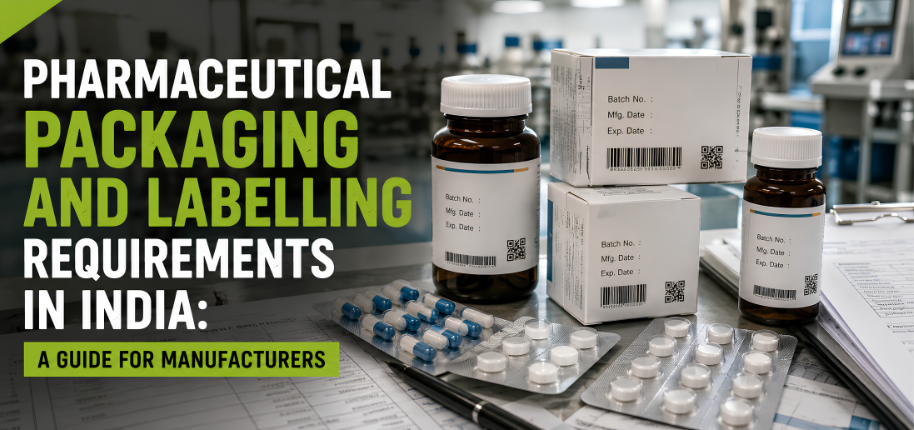
When a pharmaceutical product reaches the market, its packaging does more than protect the medicine. The pack needs to preserve the product, communicate essential information clearly and meet the regulatory requirements applicable to that particular medicine.
For pharmaceutical manufacturers, marketers and businesses using third-party manufacturing in India, packaging and labelling should therefore be considered early in the product-development process—not as an afterthought once the product is ready for sale.
India's pharmaceutical labelling requirements are primarily governed by the Drugs and Cosmetics Act, 1940 and the Drugs Rules, 1945. The exact requirements can vary depending on the product, dosage form, composition and regulatory category. Manufacturers should also keep track of subsequent amendments and notifications before approving final artwork.
Why Pharmaceutical Packaging and Labelling Matter
A pharmaceutical pack has two fundamental jobs: protect the medicine and communicate the right information.
Packaging can help protect a product from factors such as moisture, light, contamination and physical damage, depending on the formulation and its storage requirements. The label, meanwhile, helps identify the medicine and provides information required by healthcare professionals, pharmacists, distributors and patients.
For manufacturers, accurate labelling also supports:
Product identification
Batch traceability
Appropriate storage and handling
Regulatory compliance
Clear communication of warnings and precautions
Consistency across the supply chain
A well-designed pharmaceutical pack should make important information easy to locate and read while ensuring that the required declarations are not compromised by unnecessary design elements.
What Are Pharmaceutical Packaging and Labelling?
Pharmaceutical packaging refers to the containers and materials used to contain, protect, store and transport a medicine.
It is commonly considered at three levels:
Primary packaging
This comes directly into contact with the medicine. Examples include:
Blister strips
Bottles
Vials
Ampoules
Tubes
Secondary packaging
This is the outer packaging that contains the primary pack, such as a carton containing medicine strips or bottles.
Tertiary packaging
This is mainly used for transportation, warehousing and distribution, such as shipping cartons.
Pharmaceutical labelling, on the other hand, refers to the information appearing on the drug container and applicable coverings. Under the Drugs Rules, specific particulars are required depending on the product and its category.
Pharmaceutical Labelling Requirements Under the Drugs Rules, 1945
Rule 95 and Rule 96 of the Drugs Rules, 1945 are particularly relevant to pharmaceutical labelling.
Rule 95 establishes requirements relating to the labelling of drugs, while Rule 96 specifies particulars and the manner in which required information is to appear on the innermost container and other applicable coverings.
However, there is no single label template that applies identically to every pharmaceutical product.
The applicable declarations can depend on factors such as:
Type of medicine
Dosage form
Strength
Composition
Regulatory schedule
Whether the product is manufactured domestically or imported
Applicable warnings and restrictions
This is why pharmaceutical artwork should be reviewed against the requirements applicable to the specific product rather than copied from another medicine.
What Information Should a Pharmaceutical Label Include?
Depending on the product and applicable provisions, pharmaceutical labelling may require information such as:
Name of the drug
Brand or trade name, where applicable
Active ingredients and strength
Batch or lot number
Manufacturing details
Manufacturing licence information
Date-related information, including expiry requirements
Storage conditions, where applicable
Required warnings and precautions
Schedule-specific statements
Manufacturer, importer or other applicable business details
The precise requirements should always be checked against the current Drugs Rules and the provisions applicable to the individual product.
Why consistency matters
The information on a blister, bottle, carton and other packaging components should be consistent with the approved product information.
A mismatch in strength, batch information, product name or other critical details can create avoidable quality and compliance issues.
For this reason, packaging artwork should go through an appropriate regulatory and quality review before printing.
Special Labelling Requirements for Scheduled Medicines
Certain medicines have additional labelling requirements under the Drugs Rules.
For example, Schedule G, Schedule H, Schedule H1 and Schedule X medicines are subject to specific requirements, including prescribed warnings, symbols or caution statements depending on the applicable category.
Schedule H medicines, for instance, carry the prescribed Rx symbol and warning relating to sale by retail without a prescription. Other scheduled categories have additional requirements.
Manufacturers should therefore confirm the regulatory category of a product before finalising its packaging artwork.
A Recent Development: Excipients on Medicine Strips
One of the important recent developments in pharmaceutical labelling concerns excipients.
In G.S.R. 554(E), dated 18 August 2025, the Government amended Rule 96(7) to include qualitative details of excipients among the required information in the relevant context. The amendment came into effect on 1 March 2026.
This is significant for manufacturers because excipients are components of pharmaceutical formulations other than the active pharmaceutical ingredient. Certain excipients can be relevant to patients and the safe use of medicines.
For pharmaceutical businesses updating existing products or developing new products, regulatory changes such as this reinforce the importance of reviewing packaging artwork whenever applicable requirements change.
Manufacturers should not assume that artwork approved in the past will automatically remain suitable for future production.
What Should Manufacturers Consider When Choosing Pharmaceutical Packaging?
Regulatory information is only one part of the packaging decision. The packaging itself needs to be appropriate for the product.
1. Product protection
The packaging should help protect the medicine from environmental or physical factors that could affect its quality, where relevant.
2. Material compatibility
The selected packaging material should be suitable for the formulation and dosage form. Compatibility and stability considerations are important when determining the appropriate packaging system.
3. Storage and transportation
Pharmaceutical products may pass through several stages before reaching the patient. Packaging should be appropriate for expected storage, transportation and distribution conditions.
4. Readability
Critical information should remain legible throughout the product's intended shelf life.
Overcrowded artwork, extremely small text or poor contrast can make important information difficult to identify.
5. Practical usability
Packaging should also work for the people who handle and use it—whether that means opening a bottle, identifying a blister strip or distinguishing between different strengths of a product.
Pharmaceutical Artwork: What Should Be Checked Before Printing?
For manufacturers and pharmaceutical businesses, artwork approval deserves particular attention.
Before packaging is sent for printing, the responsible teams should verify:
Product name and dosage form
Strength and composition
Applicable excipient information
Batch and expiry fields
Manufacturing information
Licence details
Required warnings and symbols
Storage instructions, where applicable
Schedule-specific requirements
Pack size and quantity
Consistency between primary and secondary packaging
Legibility of critical information
Version of the approved artwork
A controlled artwork process can reduce the risk of outdated information being carried forward into production.
Common Pharmaceutical Packaging and Labelling Mistakes
Several packaging problems can be avoided through proper review and change control.
Common examples include:
Using outdated artwork
Missing a newly applicable regulatory requirement
Incorrect strength or product information
Inconsistent information between the strip and carton
Incorrect batch or expiry details
Missing schedule-specific warnings
Poor readability
Failing to update artwork after a formulation or regulatory change
Treating artwork approval as a one-time activity
The solution is not simply another design check. Packaging information should be managed as part of the broader quality and regulatory process.
What Does This Mean for Third-Party Pharma Manufacturing?
For companies outsourcing pharmaceutical production, packaging and labelling should be discussed with the manufacturing partner from the beginning.
Product composition, dosage form, pack size, regulatory category and manufacturing requirements can all influence the final packaging.
A reliable third-party manufacturing partner should be able to coordinate with the relevant quality and regulatory teams so that product information and packaging requirements are considered before production.
This becomes particularly important when a company is building a pharmaceutical product portfolio and managing multiple formulations, strengths and pack sizes.
How Agrosaf Pharmaceuticals Approaches Pharmaceutical Manufacturing
For businesses looking for a pharmaceutical manufacturing partner in India, packaging and labelling are part of a much larger product-development and manufacturing process.
Agrosaf Pharmaceuticals works with pharmaceutical businesses looking for manufacturing support across their product requirements. A structured approach to product information, manufacturing, packaging and quality helps businesses move from product planning towards a market-ready pharmaceutical product.
For companies considering third-party pharmaceutical manufacturing in India, the right manufacturing partner should be evaluated not only on production capacity, but also on quality systems, regulatory understanding, product capabilities and the ability to support consistent execution.
Frequently Asked Questions
What are the pharmaceutical labelling requirements in India?
Pharmaceutical labelling requirements are primarily prescribed under the Drugs Rules, 1945. The exact declarations depend on the medicine, dosage form, composition and applicable regulatory category.
What is Rule 96 of the Drugs Rules, 1945?
Rule 96 specifies requirements concerning the particulars and manner of labelling applicable to drugs, including information required on the innermost container and other coverings.
Are Schedule H medicines subject to additional labelling requirements?
Yes. Schedule H medicines have prescribed labelling requirements, including the applicable Rx symbol and caution statement. Other scheduled categories may have additional requirements.
What changed regarding excipients in pharmaceutical labelling?
G.S.R. 554(E), dated 18 August 2025, amended Rule 96(7) to include qualitative details of excipients in the relevant labelling requirements. The amendment took effect on 1 March 2026.
Why is pharmaceutical artwork approval important?
Artwork contains regulatory and product information that appears on the final packaging. Reviewing it before printing helps identify inconsistencies, outdated information and missing applicable requirements.
Is the same packaging and labelling format applicable to every medicine?
No. Requirements can vary according to the product, dosage form, composition, regulatory schedule and other applicable provisions. Manufacturers should verify the requirements for the specific product.
Final Takeaway
Pharmaceutical packaging and labelling in India involve much more than selecting a carton design or printing a product name. The packaging needs to protect the product, communicate important information and comply with the requirements applicable to the particular medicine.
For manufacturers and pharmaceutical businesses, the best approach is to treat packaging artwork as part of the product quality and regulatory workflow. Regular review is particularly important as regulations and labelling requirements change.
For businesses working with a third-party pharmaceutical manufacturer, choosing a partner that understands manufacturing, quality and packaging requirements can make the product-development process more structured and reliable.
Looking for a pharmaceutical manufacturing partner in India? Connect with Agrosaf Pharmaceuticals to discuss your product and manufacturing requirements.
Regulatory note: Pharmaceutical labelling requirements can change and may differ by product, dosage form, composition and regulatory category. This article is for general educational purposes and should not be treated as legal or regulatory advice. Manufacturers should verify the latest applicable requirements and notifications before approving final packaging artwork.
Sources
Central Drugs Standard Control Organisation (CDSCO), Drugs Rules, 1945
Ministry of Health and Family Welfare, G.S.R. 554(E), Drugs (Second Amendment) Rules, 2025
Department of Consumer Affairs, Legal Metrology (Packaged Commodities) Rules, 2011
Conclusion / Notes
Pharmaceutical packaging and labelling are an essential part of product quality, regulatory compliance and safe medicine use. Manufacturers should review packaging artwork against the latest applicable requirements and ensure that product information remains accurate and consistent. For businesses looking for reliable third-party pharmaceutical manufacturing support in India, Agrosaf Pharmaceuticals can help with product manufacturing requirements and related processes.
0 Comments
Recent Posts